
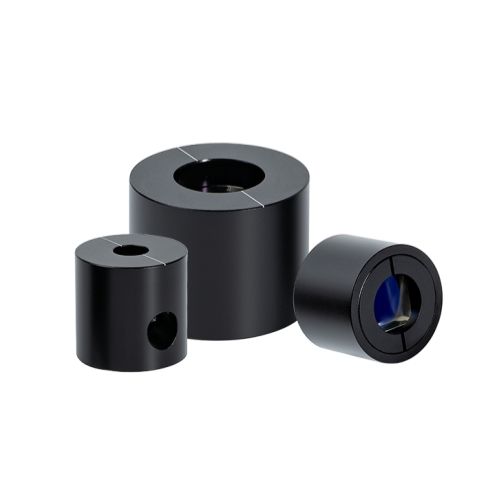
Glan-Taylor Polarizing Prism
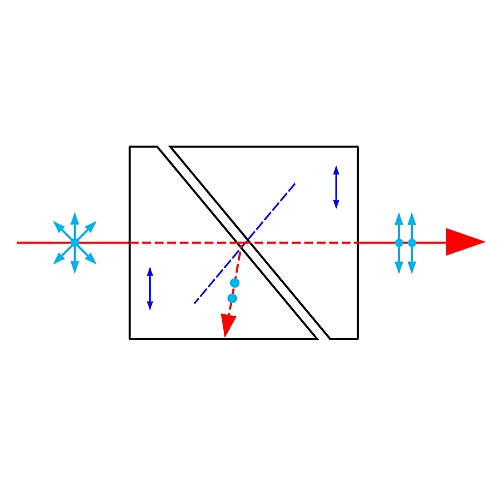
The Glan-Taylor polarizing prism is suitable for laser beams within the wavelength range of 350 nm to 2.5 μm. It is assembled from two negative uniaxial crystal prisms with mutually parallel optical axes. The air-gap structure enables a high laser damage threshold for high-power operation.
The transmitted beam is the extraordinary ray (e-ray, P-component) with an extinction ratio exceeding 100,000: 1, ideal for applications requiring high-quality polarized light. The reflected light escapes from the side outlets of the prism, containing all ordinary rays (o-ray) and partial extraordinary rays (e-ray). Two side ports are designed for bidirectional use of the prism.
Note that the Glan-Taylor polarizing prism is only applicable to collimated beams. Convergent or divergent incident light will fail to produce total internal reflection, or cause the reflected light unable to exit from the side windows.
- Air-gap design, suitable for medium and low power applications
- Equipped with two escape windows to absorb reflected light
- Incident angle close to Brewster’s angle for low reflection loss
- Extinction ratio ≥ 10⁵: 1
The Glan-Taylor prism features a broader spectral range, higher beam transmittance and superior polarization degree. Adopting an air-gap structure, the incident angle at the reflecting interface is close to Brewster’s angle, which minimizes reflection loss and delivers high laser damage resistance. Glan-Taylor prisms have a relatively small angular aperture: the full angular aperture is only 8°, with a symmetric angular aperture of 5.5°.
Parameters
| Material | Calcite* | Wavefront Distortion | λ/8 |
| Extinction Ratio | > 1 x 10⁵: 1 | Beam Deviation | 3′ |
| Wavelength Range | Calcite: 350 nm~2500 nm | Damage Threshold | CW: 100 W/cm² |
| Transmittance | > 85%, λ0 = 632.8 nm | Pulse: 200 MW/cm² |
* a-BBO, YVO4 upon request. a-BBO: 220-3000 nm;YVO4: 500-4000 nm.
- Calcite is a temperature-sensitive crystal. Large temperature fluctuations may cause cracking. Please store and use it in a proper environment. Allow the component to reach thermal equilibrium for 6–8 hours before unpacking.
- Calcite is a soft material susceptible to scratches. Handle with care, avoid touching the optical surfaces, and clean only with an air blower.
Model
| Material | Wavelength, nm | Aperture, mm | Outer Dia., mm | Extinction Ratio |
| Calcite | 350~2500 | 5 8 10 12.7 15 18 | Φ15 Φ25.4 Φ25.4 Φ25.4 Φ30 Φ38 | 10⁵:1 |