
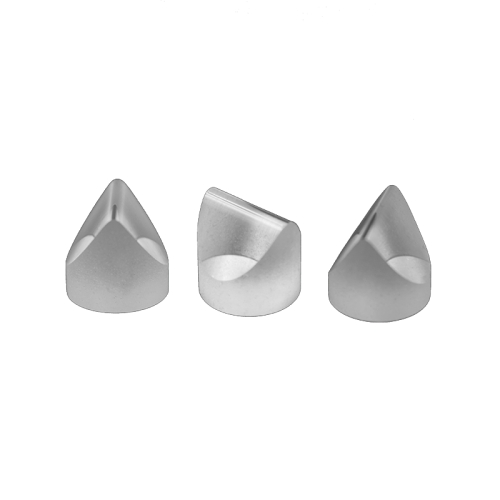
Powell Prism
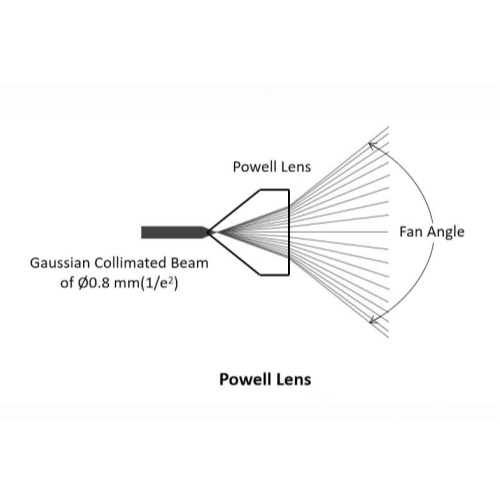
A Powell prism converts a collimated laser beam into a uniformly illuminated straight line beam. Unlike cylindrical lenses that produce Gaussian lines with a bright center and fading edges, the Powell prism redistributes the optical power of an incoming collimated Gaussian beam, outputting a fan-shaped line beam with highly uniform energy distribution.
The Powell prism features an aspheric entrance surface and a plano exit surface, both coated with broadband anti-reflection coatings for the 400 nm–700 nm spectral range, yielding an average reflectance below 1% per surface.
This prism is highly sensitive to the input beam diameter. This series is optimized for a 1 mm incident spot. A spot larger than 1 mm will cause bright spots at both ends of the output line; a spot smaller than 1 mm results in a brighter center and darker line ends. At 633 nm wavelength, the intensity variation is less than 20% across 80% of the line length, with linearity better than 0.1%. Custom specifications including alternative incident spot sizes and outer dimensions are available upon request.
Powell prisms are widely applied in laser alignment, beam shaping, scanning, precision inspection, and machine vision systems.
Parameters
| Material | H-K9L | Surface Quality | Ⅳ(Equivalent to 80/50) |
| Input Beam Dia. | 1 mm(1/e²) collimated Gaussian beam | Clear aperture | > Φ6 mm |
| Fan divergence angle | 30°, 45°, 60°, 75°@633 nm | Coating | Rave < 1%@AR400-900 nm |
| Diameter Tolerance | 0/- 0.2 mm |
Model
| Size, mm | Fan divergence angle |
| Φ9 × 8.5 | 30°, 45°, 60°, 75° |