
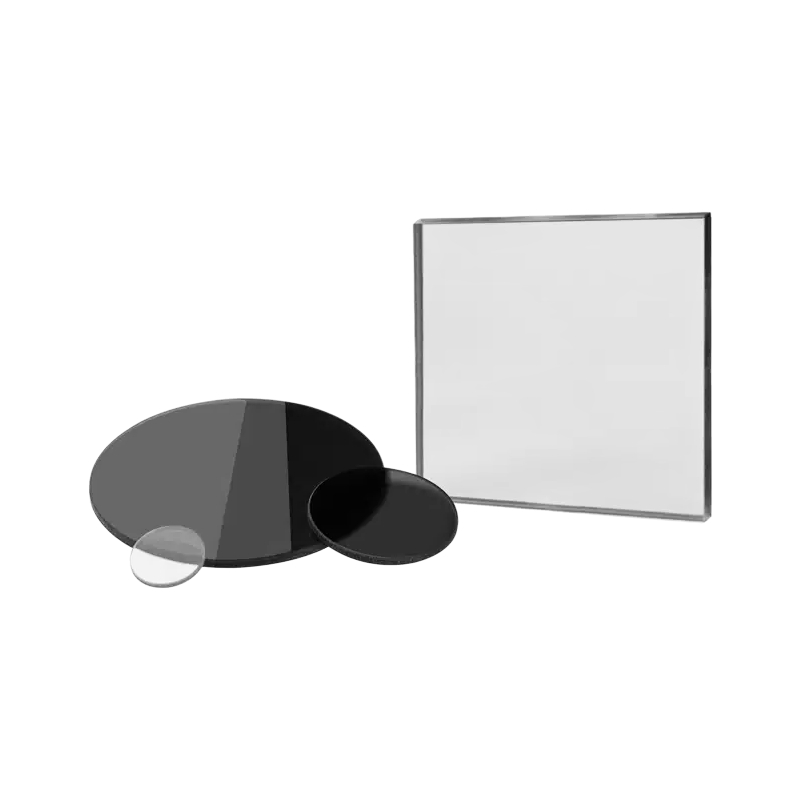
Absorptive Neutral Density Filters, 400-700 nm
Absorptive Neutral Density (ND) Filters are also known as neutral density discs, neutral filters, ND filters, attenuation filters, and fixed density filters. An absorptive neutral density filter is made of base materials doped with specific elements. It absorbs light at certain wavelengths while imposing little or no influence on other wavelengths. Generally, absorptive ND filters have a relatively lower laser damage threshold and may generate heat after prolonged operation, which should be noted during application.
These filters possess level spectral transmittance characteristics in the visible region and attenuate light by absorption with minimal reflection comparing with reflective ND filters. Typically, neutrality and density of absorptive filters are a function of the material and the thickness. They are useful in light control applications for measuring instruments and exposure control in imaging. Spectral variations occur as optical density increases. Optical Density exhibits an additive relationship; for example, stacking filters with OD values of 0.6 and 0.9 yields a resultant density of 1.5.
Parameters
| Material:Neutral grey glass | Thickness: ± 0.5 mm |
| Flatness: λ/4@633 nm | Application Range:400~700 nm |
| Parallelism: < 1′ | OD Tolerance*: ± 5% @633 nm |
| Surface Quality: 60/40 | Clear Aperture: > 90% |
| Dimension Tolerance:+ 0.0/ -0.2 mm | Optical Density(OD)*: OD = -log(T/100), T = transmission |
*Measurement datas are available for all products.
Model
| Size(mm) | Working wavelength(nm) | Optical density | Transmission T(%) | Thickness(mm) |
| Φ12.5/Φ25.0/ Φ50.0/50.0 x 50.0 | 400~700 | 0.1 | 79% | 1.33 |
| 0.15 | 70% | 2.37 | ||
| 0.2 | 63% | 1.52 | ||
| 0.3 | 50% | 2.44 | ||
| 0.4 | 40% | 1.36 | ||
| 0.5 | 32% | 1.74 | ||
| 0.6 | 25% | 2.11 | ||
| 0.7 | 20% | 1.40 | ||
| 0.9 | 12.50% | 1.82 | ||
| 1.0 | 10% | 2.03 | ||
| 1.3 | 5% | 2.30 | ||
| 2.0 | 1% | 1.25 | ||
| 3.0 | 0.1% | 1.89 | ||
| 4.0 | 0.01% | 1.25 |