
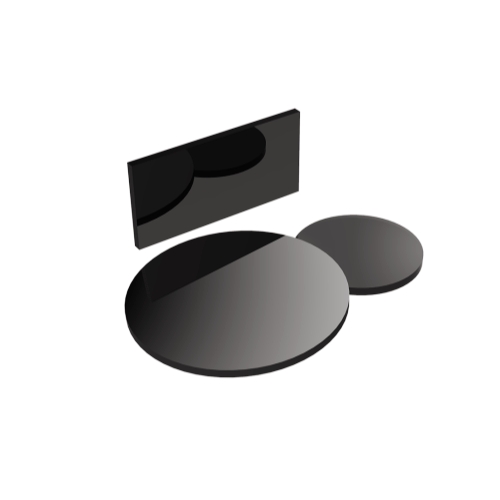
VIS-NIR Reflective ND Filters, 400-1100 nm
These filters have constant density values across the surface. The transmission to reflection ratio varies with density selection. In stacks, the total density is the sum of each filter’s density. ND filters are used primarily for the attenuation of light over a wide spectral range. Orient mirrored side toward source at 0° angle of incidence.
ND filters reflect the non-transmitted light to uniformly reduce the transmittance within a specific spectral range. Reflective neutral density (ND) filters adopt the principle of thin-film interference, allowing part of the light to transmit while reflecting the rest. Metal-coated ND Filters features broadband application, uniform spectral attenuation and low light loss. They are widely applied in optical imaging systems, smokemeters, optical measuring instruments, near-infrared spectrometers, biochemical analysis equipment and other fields.
Parameters
| Material:H-K9L (CDGM) | Thickness:2 ± 0.2 mm |
| Flatness:λ/4@633 nm | Application Range:400~1100 nm |
| Parallelism:< 30″ | OD Tolerance*:± 5%@550 nm |
| Surface Quality:60/40 | Clear Aperture:> 90% |
| Dimension Tolerance:+ 0.0/ -0.2 mm | Optical Density(OD)*:OD= -log(T/100) |
*Measurement datas are available for all products.
Model
| Size(mm) | Working wavelength | Optical density | Transmission T(%) | Design wavelength |
| Φ12.5/Φ25.0/50.0 x 50.0 | 400~1100nm | 0.1 | 79% | 550nm |
| 0.2 | 63% | |||
| 0.3 | 50% | |||
| 0.4 | 40% | |||
| 0.5 | 32% | |||
| 0.6 | 25% | |||
| 0.7 | 20% | |||
| 1.0 | 10% | |||
| 1.3 | 5% | |||
| 2.0 | 1% | |||
| 3.0 | 0.1% |