
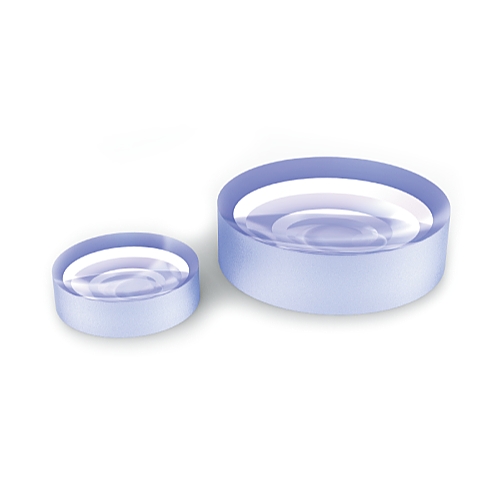
Calcium Fluoride(CaF₂) Plano-concave Lenses, Uncoated/AR3~5μm
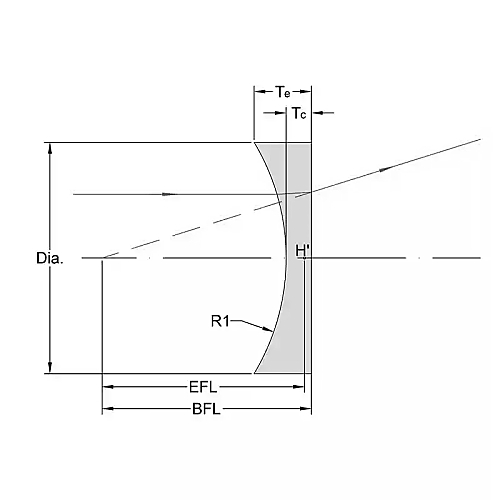
Tuniu Optics Calcium Fluoride (CaF₂) plano-concave lenses convert collimated incident light into diverging rays, which converge virtually at the lens’s virtual focal point with a negative focal length. The lens features one flat surface and one concave surface.
A plano-concave lens can diverge a collimated beam emitted from a virtual focal point and is commonly adopted in Galilean beam expanders. For optimal performance, orient the concave surface toward the incident light and the plano side toward the target focal plane. With negative focal length and negative spherical aberration, plano-concave lenses can compensate for aberration introduced by other optical elements in the system.
When selecting between plano-concave and biconcave lenses for diverging collimated beams, plano-concave lenses are preferred if the required magnification is less than 0.2 or greater than 5; for magnification between these values, biconcave lenses are typically used.
Calcium Fluoride offers a broad transmission spectrum ranging from 180 nm to 8.0 μm. It features a high laser damage threshold, low fluorescence, and excellent optical homogeneity. The material is relatively soft and prone to surface scratches. It is widely used for laser collimation and serves as an ideal substrate for various optical components such as lenses and optical windows.
Parameters
| Material | CaF2 single crystal |
| Design Wavelength | 587.6 nm |
| Surface Quality | 60-40 |
| Diameter Tolerance | + 0.0/- 0.1 mm |
| Center Thickness Tolerance | ± 0.1 mm |
| Focal Length Tolerance | ± 1 % |
| Centering Tolerance | < 3 arcmin |
| Clear aperture | > 90% |
| Bevel | 0.2 mm X 45° |
| Coating | Uncoated, Ravg < 1.5%@3~5 μm |
Model
| Dia., mm | Focal Length, mm | Coating |
| φ12.7 | -18/-25 | Uncoated, Double-Sided-AR-coating@3~5 μm |
| φ25.4 | -40/-75/-100/-200/-500 |